12 questions about your eBike battery

The battery is the energy source of your eBike. It supplies the drive unit with power and has a critical influence on the range. If you follow a few simple rules for handling, care and transport, this will have a positive effect on the safety and durability of your eBike battery. Dr Vikram Godbole, Senior Product Manager for batteries and chargers at Bosch eBike Systems, explains what is important and how you can implement these tips.
1. What are the characteristics of lithium-ion batteries?
Vikram Godbole: Lithium-ion batteries are among the most up-to-date and common eBike batteries around. They are characterised by high mileage, low self-discharge and long service life with low weight. Thanks to their high energy density, they can store a lot of energy in a small space and are quickly ready for use even after long periods of storage – without the need for lengthy recharging. That is why we rely on lithium-ion technology for all Bosch eBike batteries.
2. What role does safety play for eBike batteries?
Vikram Godbole: Lithium-ion batteries are complex in structure, have a high energy content and can cause danger as certain constituents are flammable. For this reason, eBike batteries must undergo extensive legally prescribed tests (e.g. leakage tests, overcharging and short-circuit tests) and may only be placed on the market once they have passed these tests. Bosch eBike Systems goes above and beyond the strict legal requirements with certain tests. We test the battery cells in other short-circuit scenarios in addition to the prescribed short-circuit test, for example.
3. What additional measures has Bosch eBike Systems taken to make eBike batteries safer?
Vikram Godbole: Safety is our top priority. That is why, in addition to the additional tests, we have taken further measures safety measures depending on the design and generation to make our batteries safer and ensure consistently high quality. This starts with the selection of the battery cells that we purchase from suppliers. Here we only work with renowned cell manufacturers. They develop the cells based on our strict requirements for cell quality and safety. To ensure that this is regularly checked, we have introduced quality controls that go above and beyond the standard.
We have designed our batteries in such a way that the risk of a short circuit or overheating is reduced by the mechanical, electrical and thermal separation between the battery cells. The condition of the battery is monitored by the intelligent Battery Management System. It detects potential fault sources and protects against excessive operating temperatures, overload and deep discharge. In addition, the sealing concept of a Bosch eBike battery protects against water ingress and therefore against consequential damage.
The high degree of automation in the production of the smart system's batteries, including strict quality controls, also contributes to the safety of our batteries. In addition, we have our batteries assessed by accredited laboratories for compliance with the standards.
4. What basic rules must I observe when handling my eBike battery?
Vikram Godbole: It is important for the battery to be protected from heat, direct sunlight and fire. In addition, the battery must not be immersed in water or cleaned with a high-pressure cleaner. If you are transporting your eBike on a car rack, remove the battery if possible. Also keep the battery away from small metal objects such as keys, nails or screws. There is a risk that contacts will be bridged, resulting in a short circuit. Also note that the housing must not be opened. This is exclusively reserved for competent persons after qualification and training. Opening the battery always means interfering with their certified condition and entails safety risks.
5. What is the service life of an eBike battery?
Vikram Godbole: An exact service life cannot be predicted. The currently available capacity of your Bosch eBike battery can be determined by your eBike dealer using the CapacityTester. In principle, however, batteries are wearing parts. The more intensively you use your battery, the faster it ages. A "memory effect", i.e. decreasing capacity due to frequent incomplete discharge, does not occur with lithium-ion batteries. However, even if you do not use the eBike battery, it will age over time. This is due to chemical reactions in the battery cells. If the battery is exposed to high temperatures or is stored at a low or high state of charge, this also leads to a shorter service life. A long service life is fundamentally important to us, which is why our cell suppliers have to fulfil high requirements.
6. What other aspects should I consider for storage?
Vikram Godbole: If you are not using the eBike for a longer period of time, you should remove the battery from the eBike if possible. Ideally, you should store your battery with a charge level of 30 % to 60 % and temperatures between 0 °C and 20 °C in a dry environment or between 10 °C and 20 °C in a humid environment with dew formation. The best place to store them is in a well-ventilated room with a smoke detector, away from heat sources or highly flammable materials. Due to the cool temperatures, storing the battery in a basement or garage is better than storing it in living spaces.
7. What points should I remember in winter?
Vikram Godbole: In general, cold reduces the performance of the battery. In winter when using at temperatures below zero degrees, it is advised to bring the battery into a heated area before setting out and wait until it has warmed up to room temperature. If the eBike is not in use for a longer period of time, for example in winter, the instructions for correct storage apply.
8. How do I charge my eBike battery correctly?
Vikram Godbole: Before charging, you should check the eBike battery for visible damage. You should also let it cool down. It is also important to ensure that your charger is compatible with the battery: please only use chargers that are compatible with Bosch eBike batteries. This helps protect the battery from damage and prevents dangers such as overheating or short circuits. With original Bosch chargers, you are always on the safe side. When charging, the ambient temperature should be between 0 °C and 40 °C and ideally at room temperature. A dry environment with a smoke detector and without direct sunlight is also important. Whether full, half full or empty: you can charge batteries with lithium-ion cells for as long as you like, irrespective of their state of charge. Interruptions of the charging process do not harm the battery. However, only fully charge the battery if it is really necessary. Disconnect the battery and charger from the mains after charging.
9. How long does it take to charge my eBike battery?
Vikram Godbole: The charging time depends on the capacity of your battery and the charger used. For eBikes with the smart system, it ranges from just over an hour to around five hours for half a charge. To fully charge the battery, it takes between approximately three and eleven hours. You can find the exact details here: Charger overview
10. What must I bear in mind when cleaning the battery?
Vikram Godbole: If possible, remove the battery before cleaning your eBike. We recommend wiping the battery down with a damp cloth. The plug poles of the eBike should also be cleaned occasionally and lightly greased with technical Vaseline. To protect the electronics, you must not clean the battery with a direct water jet or high-pressure cleaner. You should also avoid using strong cleaning agents. They might affect the surface.
11. How far can I ride with my eBike battery?
Vikram Godbole: For many eBikers, this is a key question to which there is no absolute answer. The answer can differ enormously: less than 50 kilometres are possible with one battery charge in the smart system as well as up to approx. 170 kilometres. This is because the range depends on many factors: the support level, riding style, air resistance, the cyclist’s weight, tyre pressure and, of course, the terrain. Our range assistant allows you to estimate a typical range under various parameters. You can find out how to optimise your range, for example, in our Help Center.
12. How do I dispose of my eBike battery?
Vikram Godbole: Once a battery has reached the end of its lifetime, it must be disposed of appropriately. For safety reasons, you should have defective, old or used batteries properly recycled. You can usually return old batteries free of charge to a specialised bicycle retailer. There they are collected by authorised battery collection systems and sent for recycling. Almost 71 % of raw materials of a used eBike battery can be recovered and used for new products Source: Gemeinsames Rücknahmesystem Servicegesellschaft mbH (2023): "Increasing sustainability by taking back used batteries from eBikes and other small electric vehicles", presented at Eurobike 2023..
More information and tips on handling the battery can be found in the battery guide.
About Dr Vikram Godbole
Dr Vikram Godbole holds a doctorate in electrochemistry with a focus on lithium-ion cells and has been working as a battery expert at Bosch eBike Systems for over ten years. He is currently Senior Product Manager for batteries and chargers and is responsible for defining new eBike batteries and chargers. In his free time, Vikram enjoys travelling on two wheels – both on his trekking bike and on his motorbike.
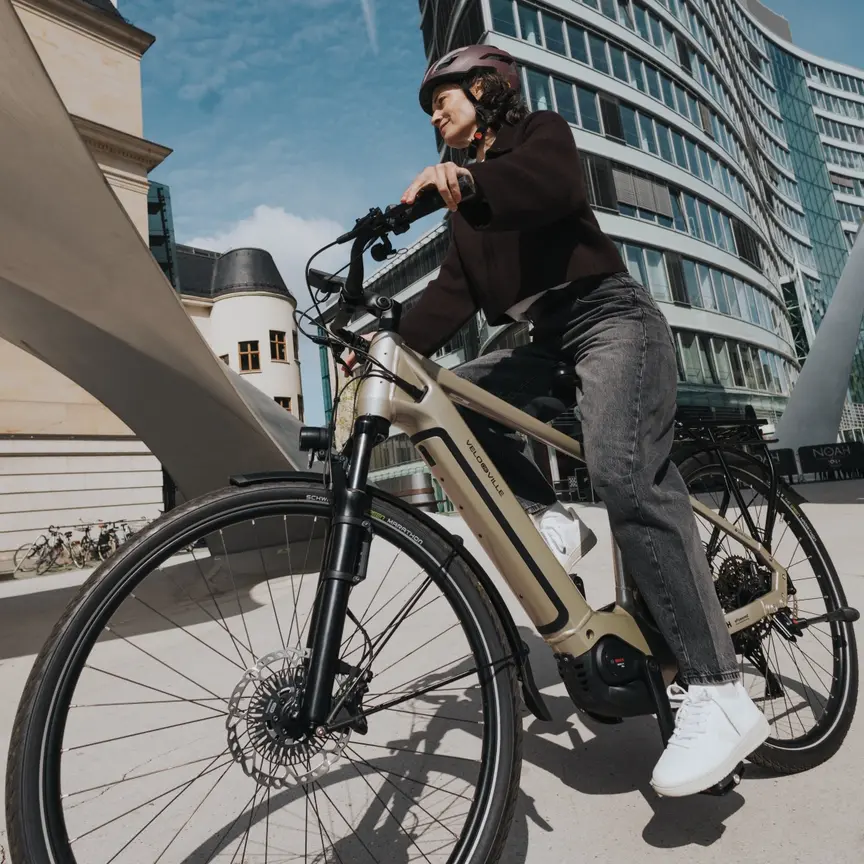
Your safety. Our priority.
eBike battery safety
Safety is our top priority – including our rechargeable batteries. We show you how we are constantly making our batteries safer. And how to charge, store, care for and transport your battery correctly.


